
Swiftdrain Driveway Trench Drains
6" , 8" or 12" wide
Grate options include ductile iron, polymer and stainless steel
Slip joints for fast and easy installation
Anchors for rebar
Questions: 646-227-0910
Residential and Driveway Channel Drains
Channel drains, trench drains or strip drains are linear drainage applications used to prevent surface and rain water from flooding garages, basements, driveways and gardens.
View 2026 Driveway Drainage Guide Here
The Ultimate Guide to Driveway Trench Drain Systems (2026)
Types, Sizes (6â€, 8â€, 12â€), Load Ratings, and Proper System Design
Water is one of the most destructive forces acting on your driveway. Whether it’s pooling at your garage entrance, eroding your base layer, or freezing into dangerous ice patches, unmanaged runoff leads to expensive repairs and long-term structural damage.
That’s where driveway trench drain systems (also called channel drains) come in. These engineered linear drainage systems are designed to intercept water across the entire width of a driveway and redirect it safely away from structures. They are generally found in outdoor or exterior application applications.
In this comprehensive guide, we’ll break down everything you need to know to choose the right system—including types, widths (6â€, 8â€, 12â€), load ratings, hydraulic capacity, and accessories like catch basins—with expert insights tailored for high-performance solutions like those offered by Swiftdrain.
What Is a Driveway Trench Drain?
A trench drain (channel drain) is a long, narrow drainage system installed flush with the surface of a driveway. It collects water through a grated opening and channels it to an outlet pipe or drainage system.
Key benefits include:
• Captures sheet flow across the full width of a driveway
• Prevents water intrusion into garages and foundations
• Reduces erosion, cracking, and freeze-thaw damage
Unlike point drains, trench drains are continuous, making them far more effective at handling large volumes of surface runoff.
Types of Driveway Drainage Systems
1. Trench / Channel Drains (Primary Solution)
These are the most effective and widely used systems for driveway drainage.
Best for:
• Garage entrances
• Sloped driveways
• Areas with consistent sheet flow
Key components:
• Channel body (HDPE, polymer concrete, or concrete)
• Grate (cast iron, stainless steel, or polymer)
• End caps and outlets
Modern systems such as those from Swiftdrain feature pre-sloped channels (typically 0.5%–1%), ensuring efficient water flow without complex grading.
2. Catch Basins (Point Drain Support)
A catch basin is a box-style drain installed at low points.
Best for:
• Collecting water at a single location
• Capturing debris such as leaves and sediment
• Connecting trench drains to underground piping
They include a sump area that traps debris before it enters the drainage system.
Best practice is to use a trench drain for water collection and a catch basin for filtration and discharge.
3. Hybrid Systems (Best Practice)
The most effective driveway drainage designs combine:
• A trench drain across the driveway
• A catch basin at the outlet
This configuration maximizes water capture, reduces clogging, and improves long-term maintenance.
Standard Driveway Trench Drain Widths
Choosing the correct width is critical for both capacity and performance.
6-Inch Trench Drain Systems
• Ideal for most residential driveways
• Handles moderate rainfall and runoff
• Common choice for standard homes
Performance insight:
A properly designed 6-inch system can handle significant flow rates, making it suitable for typical residential applications.
Best for:
• Standard homes
• Light vehicle traffic
• Moderate drainage needs
8-Inch Trench Drain Systems
• Mid-range capacity upgrade
• Handles higher flow rates and wider drainage areas
Best for:
• Larger driveways
• Steeper slopes
• Regions with heavy rainfall
12-Inch Trench Drain Systems
• High-capacity, heavy-duty solution
• Designed for severe drainage conditions
Best for:
• Commercial driveways
• Long slopes or large contributing areas
• Flood-prone environments
General guideline:
• 6â€â€“8†systems are suitable for moderate drainage
• 12†systems are recommended for high-volume or high-risk scenarios
How to Size a Driveway Trench Drain System
Proper sizing depends on hydraulic capacity, not just width.
Key factors include:
1. Drainage Area
Larger driveways generate more runoff, especially since paved surfaces are impermeable.
2. Rainfall Intensity
Local rainfall rates directly impact required system capacity.
3. Slope
Steeper slopes increase water velocity and total flow volume.
4. Channel Capacity
Capacity is typically measured in gallons per minute (GPM) and must exceed peak flow conditions.
For most residential driveways, 6-inch or larger systems are recommended to ensure sufficient capacity and prevent overflow.
Load Ratings: Matching the Drain to Vehicle Traffic
Load rating is critical when selecting a trench drain system.
General US Load Classes:
- • A15- pedestrian
- B125: Pedestrian and light residential traffic
- • C250: SUVs, pickup trucks, and light commercial vehicles
- • D400 and above: Heavy trucks and industrial use
Residential driveways typically require B125 or C250 rated grates.
Choosing an insufficient load rating can lead to structural failure, cracked grates, and safety hazards.
Materials Matter: Durability and Performance
Modern trench drain systems are constructed from:
Channel Materials
• HDPE (High-Density Polyethylene)
Lightweight, corrosion-resistant, and easy to install
• Polymer Concrete
High strength and chemical resistance
• Traditional Concrete
Heavy-duty but more labor-intensive
Grate Materials
• Cast iron: Maximum strength and durability
• Stainless steel: Corrosion resistance and clean appearance
• Polymer: Lightweight and cost-effective for light-duty use
The Role of Catch Basins and Accessories
Accessories play a crucial role in system performance and longevity.
When You Need a Catch Basin
Install a catch basin if:
• You expect leaves, debris, or sediment
• Your system connects to underground piping
• You want easier maintenance access
Benefits
• Prevents clogging
• Extends system lifespan
• Improves overall drainage efficiency
Additional accessories may include:
• End caps
• Bottom or side outlets
• Debris strainers
Pre-Sloped vs Neutral Channels
Pre-Sloped Systems
• Built-in slope (typically 0.5%–7%)
• Faster and more reliable installation
• Improved hydraulic performance
Neutral (Flat) Systems
• Require manual slope during installation
• More labor-intensive
• Higher risk of installation error
For most driveway applications, pre-sloped systems are the preferred choice.
Installation Best Practices
• Install the trench drain across the full width of the driveway
• Ensure proper concrete encasement for structural support
• Set grate height flush with the finished surface
• Connect to an appropriate discharge point such as a storm drain or dry well
Final Thoughts: Choosing the Right Driveway Drain
Selecting the right trench drain system comes down to three primary considerations:
1. Width
• 6-inch: Standard residential
• 8-inch: Higher capacity
• 12-inch: Heavy-duty applications
2. Load Rating
Choose based on expected vehicle traffic.
3. System Design
A combined trench drain and catch basin system provides optimal performance.
4. And of Course- aesthetics. a decorative trench drain system can enhance and bring out the hard scape and exterior landscape or driveway and even pool and complement the layout of both residential and commercial applications alike. decorative grading can be utilized and residential driveway applications in both stainless steel and ductile iron.the ductile iron is generally available in a nice patina finish with different design variations. That goes quite well with most rustic looks.
Why Swiftdrain THE Leading and Logical Choice
Swiftdrain systems offer:
• Pre-sloped HDPE channels (also HPC Concrete channels, stainless, fiber and polymer concrete)
• High flow capacity
• Multiple width options (6â€, 8â€, 12â€)
• Durable grate selections
• Streamlined installation design
We pride ourselves on customer success. going 10 years strong we aim to provide drainage solutions from critical and complex to simple and easy; all the same. with the same vigor consistency and customer service. residential driveways such as these at times take more technical support and guidance than complicated municipal projects and we are here to help guide you along the way with product technical data to make a well informed decision.
Our goal and mission has been simple, to ensure that everyone that deals with Swiftdrain is better off because of it.
Let’s take a deeper look into channel drains
Channel drains are straight drainage strips that collect and convey surface water. They can be found on driveways, around pools, parking lots among other places. Channel drains are an effective way to collect water before drainage issues arise. Excess water around a house can seep into a basement and cause water damage. Water can also pool around landscaping and cause damage to the exterior of a residence. Channel drains come in 5" wide , 8" wide and 12" wide sizes.
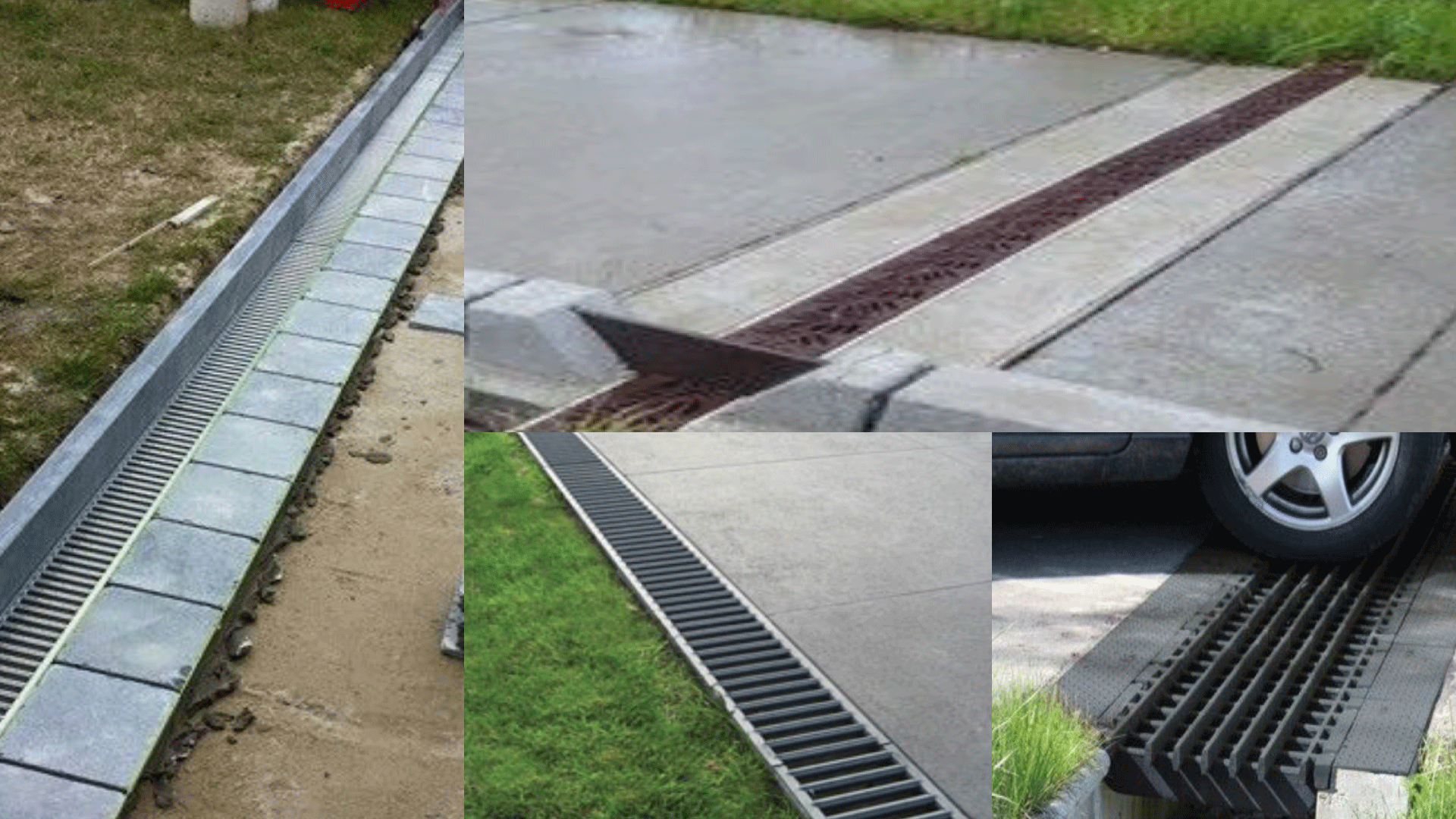
Driveway Channel Drains
There are a few different channel drain manufacturers such as NDS, TDC and Swiftdrain. It may get confusing when you find cheap channel drains for $100.00 on Amazon and are wondering what the differences are to the ones that cost more. The thing is, what you spend now is what you will save in time, cost and redoing a job later. There are cheap channel drain options, but they simply don’t last. Basic residential kits go for about $50.00-$85.00 a linear foot. This would include a metal grate, end cap, end outlet and channel. For a 12 foot garage section, one can expect to pay about $1200 in channel drain materials.
One of the first things to consider is how much water we need to drain. There are complex ways and simple ways to calculate water runoff. The simple way can be calculated with this flow chart.
We need to know how much water we will have to drain in order to select the right depth, width and length of the trench drain system. Typically, a 6â€, 8†or 12†wide channel is sufficient. Without going too crazy with flow charts and formulas, if you have moderate pooling or drainage issues go with a 6†or 8†and if you have severe pooling and drainage issues go with a 12†wide channel drain. View Driveway Channel Drain Kits.
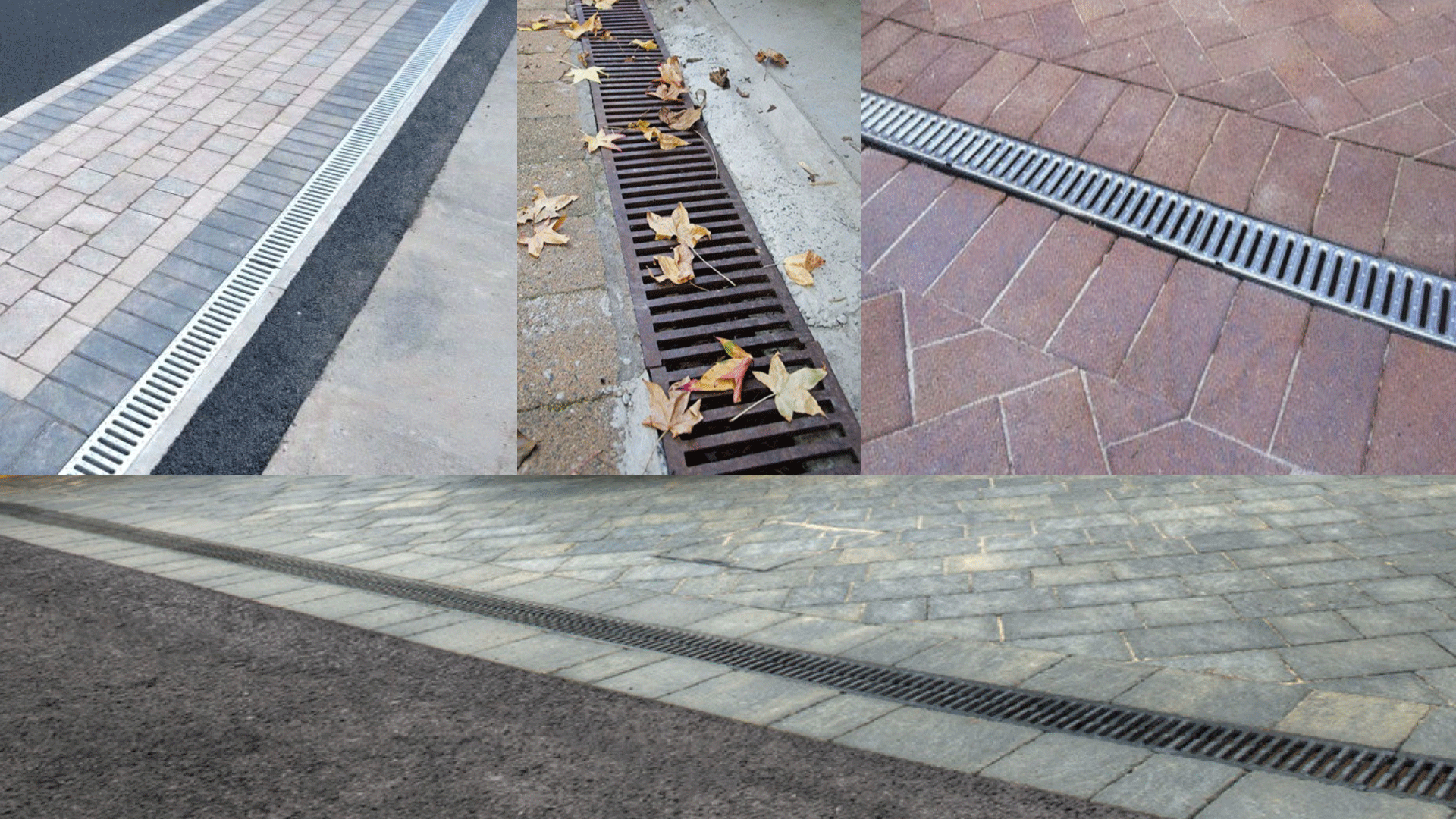
Channel Drains come in a variety of grate options
When selecting the right channel drain the following must be taken into consideration:
- The slope of the surface where the channel drain is going
- The amount of water to be collected
- What will be going over the channel drain (cars, people, pets)
- The slope of the ground leading to the channel drain affects the speed and volume of water the channel will carry. A simple and easy way of determining flow rates through the grates can be found here. Generally speaking, a pre sloped trench drain system sloped from .7% - 1% is sufficient for most residential applications.
- The amount of water to be collected can be determined by water tables flow charts. This will help us determine the width of the drain. For residential applications, 4†– 12†is usually the width selected. For most applications 6†is more than sufficient.
- What goes over the channel drain should be considered. There are different class load capacities.
-
- A – Pedestrians
- B- Small Cars
- C- Passenger Cars, SUVS and trucks
- D- Loaded Forklifts
Also, if you have animals or pets constantly going over the grates. Paw proof channel drain grates would be another consideration.
Channel Drain Grates
ADA grates or American with Disability Act are grates with holes (slots) that are smaller than 1†x 1â€. This prevents crutches and wheel chairs from getting stuck when going over the channel drain.
Channel drain grates come in plastic, cast iron, galvanized steel, stainless steel and bronze. Plastic is suitable for pedestrian and light veichular traffic. Most manufacturers include U.V. inhibitors in the grate to increase its structural lifespan. Sunlight can cause damage and cause grates to warp.
Driveway channel drains can also come furnished with frames or rails to give added support to the grates that sit on top. This will also increase the lifespan of the drain and minimizes the chance of shifting and breaking over time. It’s a slight additional cost now which increases the lifespan of the drain over time.
Decorative channel drain grates can also be used to give the driveway area an aesthetic charm. Urban Accessories, NDS and ACO carry a full line of decorative grate options. Grates can also come unpainted, bronze and with a baked on oil finish to give an added sense of design.
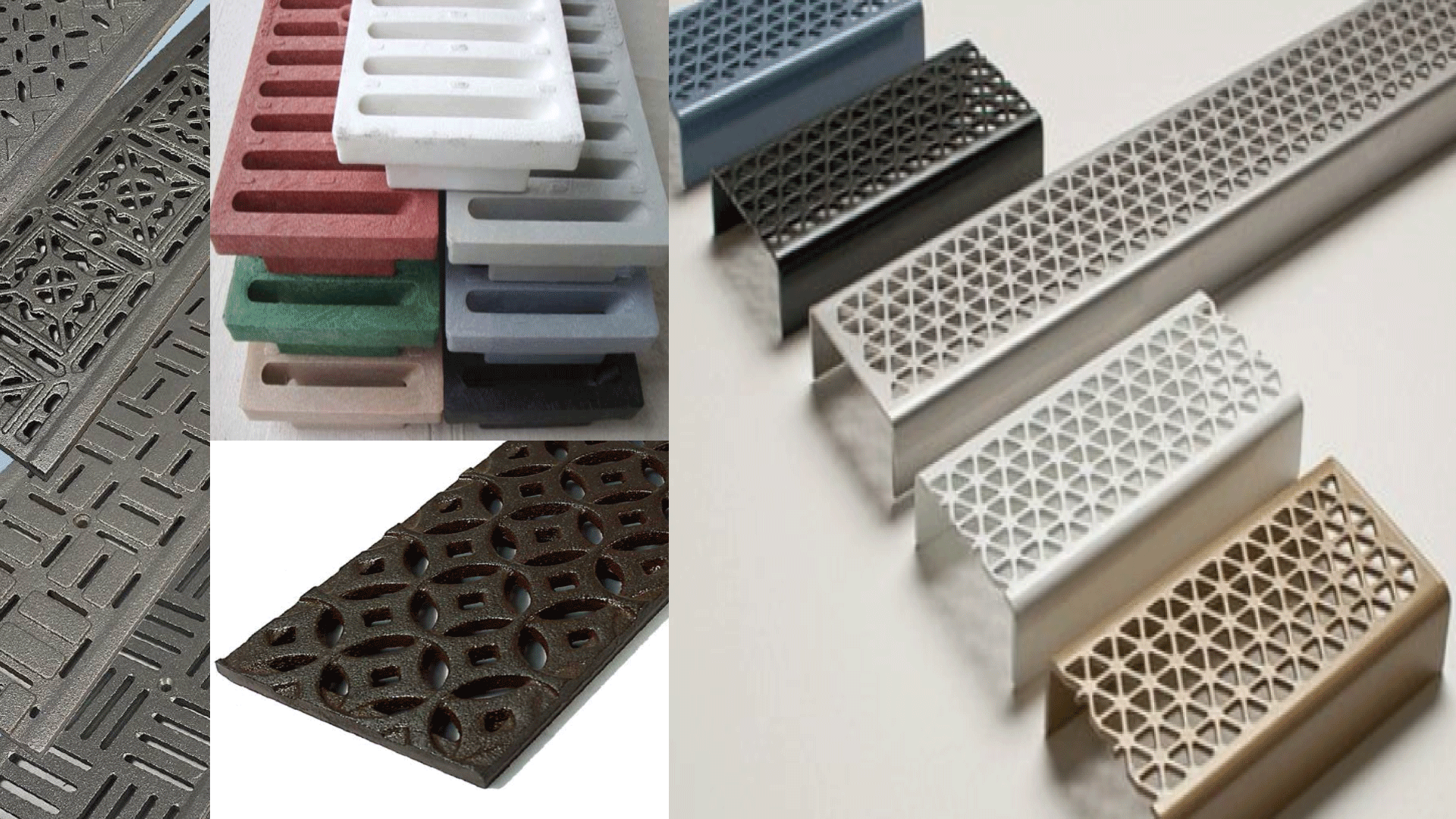
Many Grates to choose from
Accessories
Catch basins can also be added to the channel drain system to collect leaves and other debris before they enter the pipe. Channel Drains should come with one end cap, one end outlet, channel, grates and screws.
Channel Drains V.S. French Drains
A French drain is a trench filled with rocks, pebbles or gravel that contains a perforated pipe and conveys surface water from point A to point B. A French drain can have hollowed out perforated pipes along the bottom to convey water that seeps into the ground system. French drains are useful to prevent water accumulation, foundation damage, retaining wall buildup and other septic tank uses. This is THE age old question do I need a trench drain or a French drain?
French drain sizing depends on the expected water volume. Usually 2 or 3 pipes is sufficient for the drain. Filters like sand, gravel, rocks and pebbles are used to keep out particles from the surrounding soil. Gravel, stone and rock are used as permeable materials and placed around the pipe to help out with water flow.
French drains are usually buried around the foundation wall on the external side of the foundation or installed underneath the basement floor on the inside perimeter of the basement.
French drains can be a useful way to convey water but also have downsides such as expansive excavation, clogging issues and the need for a sump pump. We have seen that channel drains offer a higher success rate than French drain systems.

French Drain
The most popular channel drains are the Swiftdrain Sierra Series, NDS Pro Series, Josam and TDC 100. These channel drains have polymer and hdpe channels with a variety of grate options to choose from. The 600 series is a best in class pre sloped driveway channel drain.
Putting it all together.
A properly designed driveway trench drain system is a critical investment that protects your home, driveway, and long-term property value.
By understanding system types, sizing, load ratings, hydraulic capacity, and accessories, you can confidently select a solution that performs reliably for years to come.
For most applications, a properly sized pre-sloped trench drain system—paired with a catch basin when needed—provides the most effective and durable drainage solution available today.
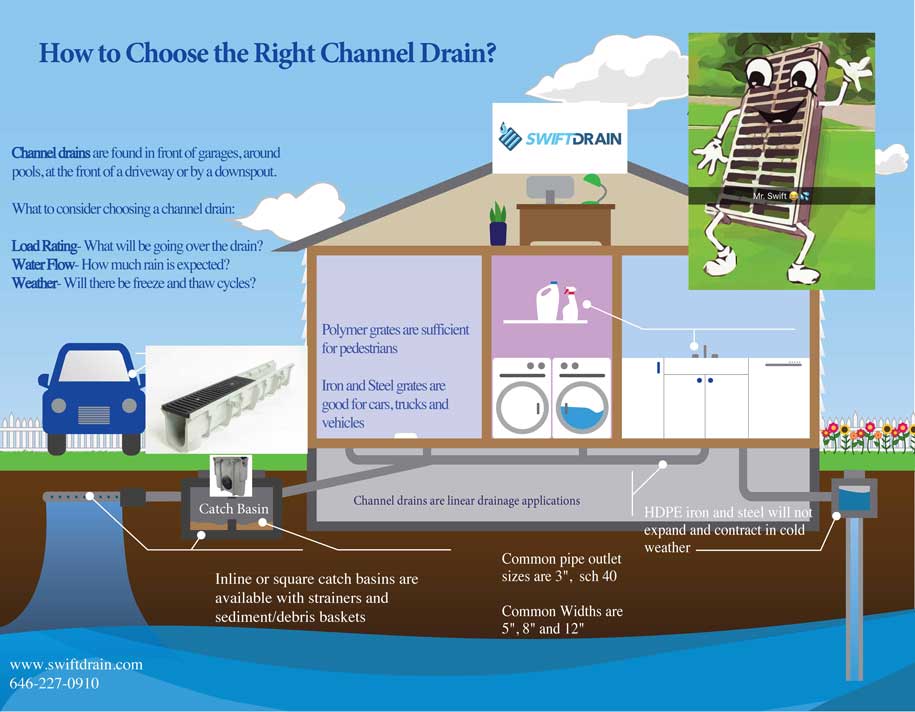
Installation